Packaging
What Changes Cosmetic Packaging MOQ?
Cosmetic packaging MOQ is shaped by more than the container itself. Learn how stock components, custom colors, decoration, molds and order structure affect the minimum quantity of your project.
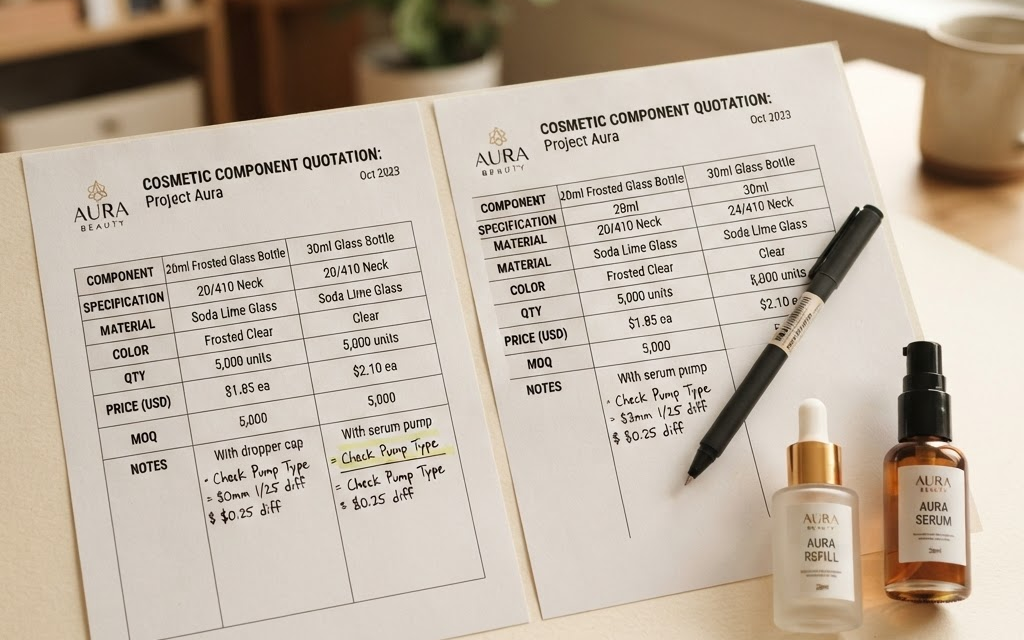
Minimum order quantity, or MOQ, is one of the first questions beauty founders ask when developing cosmetic packaging. The answer is rarely a single fixed number. A supplier may offer the same lip gloss tube at one MOQ in a stock color, another MOQ with a custom finish, and a much higher commitment when the structure needs a new mold.
Understanding what creates the MOQ helps you make better decisions before requesting quotations. It also prevents a common mistake: designing packaging that looks simple on a rendering but requires several separate production processes to manufacture.
1. Stock packaging or a custom structure
The first distinction is whether you are selecting an existing component or developing a completely new structure. Stock packaging uses an existing mold and established production process. The supplier may already manufacture the bottle, tube, cap or applicator regularly, which makes smaller production runs more practical.
A custom structure requires engineering, mold development, sampling and testing before mass production. The factory must recover setup and tooling costs, so the commercial commitment is normally much higher than it would be for an existing component.
For an emerging brand, customization does not always require a custom mold. A carefully selected stock component can still feel distinctive through color, decoration, material combinations and secondary packaging.
2. The component may be stock, but the color may not be
Selecting an existing package does not automatically mean every color is available at a low quantity. Standard black, white, transparent or supplier-stocked colors may be easier to order. A custom color requires material preparation, color matching, machine cleaning and production setup.
The color MOQ may apply to each component separately. For example, a lip gloss package may contain a bottle, cap, wiper and applicator. If several parts require custom colors or different materials, the effective MOQ and setup cost can increase.
3. Decoration processes have their own minimums
Decoration is another major MOQ driver. Screen printing, hot stamping, spray coating, metallization, heat transfer and digital printing use different equipment and setup processes. The minimum quantity can therefore change even when the underlying package remains exactly the same.
- A simple one-color logo is usually easier to arrange than several decoration processes combined.
- Spray coating adds a separate production stage before logo printing.
- Hot stamping requires suitable artwork, tooling and production setup.
- Metallized or gradient finishes may require specialized processing.
- Digital printing can be useful for shorter runs when the component and artwork are compatible.
When comparing quotations, ask whether the stated MOQ covers the undecorated component, the custom color, the logo process or the final assembled package. These numbers are not always the same.
4. Material and finish choices affect production efficiency
Plastic, glass and aluminum packaging follow different production routes. Even within one material family, wall thickness, resin selection, recycled content, surface treatment and assembly requirements can change the feasible production quantity.
A finish that appears visually subtle may involve several steps. A soft-touch bottle with a metallic cap and two-color printed logo, for example, is not one customization. It is a sequence of color preparation, coating, cap finishing, printing, curing, inspection and assembly.
5. MOQ may apply per color, size or SKU
Brands sometimes ask whether one total order can be divided across several shades or product variants. This depends on which elements are shared. If every SKU uses the same container, cap color and decoration, but only the filled formula changes, the packaging order may be consolidated more easily.
If each SKU has a different package color, printed artwork or capacity, the supplier may treat each version as a separate production run. A total order of 10,000 units divided into five different designs is not necessarily equivalent to one 10,000-unit production run.
6. Assembly and compatibility testing also matter
Cosmetic packaging is a functional system, not only a visual shell. Bottles, caps, pumps, wipers and applicators must fit correctly and work with the formula. A new component combination may require assembly trials, leakage testing, dosage checks or formula compatibility testing.
Combining components from different suppliers can create flexibility, but it may also introduce additional minimums, transport steps and quality-control requirements. The lowest individual component MOQ does not always produce the lowest or safest total project cost.
How emerging beauty brands can reduce MOQ pressure
The most effective approach is to decide which elements must be distinctive and which elements can remain standard. Instead of customizing every part, focus the budget on the details customers will notice most.
- Start with an existing mold and proven component structure.
- Use a supplier-stocked base color when possible.
- Limit the first launch to one primary decoration process.
- Use the same packaging family across multiple formulas or shades.
- Create differentiation through cartons, labels, inserts or sets.
- Approve physical samples before committing to mass production.
- Ask for separate quotations for stock, semi-custom and fully custom options.
Questions to ask before accepting an MOQ
A useful quotation should explain what the MOQ includes. Before comparing suppliers, confirm the component specification, decoration, color, assembly, testing, packaging method and expected production tolerance.
- Is the MOQ for the complete package or for each individual component?
- Does it apply per color, size, capacity or artwork version?
- Is the quoted component currently in stock or made to order?
- Are decoration minimums different from the packaging MOQ?
- Can excess undecorated components be stored for a later order?
- What sampling and testing are required before production?
- Which costs are one-time setup costs and which repeat on every order?
Build the first order around commercial reality
The right MOQ is not always the smallest number a supplier can quote. A very small order can carry a high unit cost, limited decoration choices or unstable component availability. A larger order can reduce unit cost but creates inventory and cash-flow risk.
The goal is to find the most sensible balance between brand differentiation, testing needs, launch budget and future reorder potential. Lulu Beauty Works helps beauty brands compare stock, semi-custom and fully custom packaging routes before committing to production.
Frequently Asked
Questions
- What is a typical MOQ for cosmetic packaging?
- There is no universal MOQ. It depends on the component, material, color, decoration, assembly requirements and whether an existing mold or a new custom structure is used. The supplier should confirm the minimum for the complete specification, not only the undecorated container.
- Can I order several colors within one MOQ?
- Sometimes, but each custom color may be treated as a separate production run. This depends on the manufacturing process and whether the other components and decoration remain identical.
- Does custom logo printing increase the MOQ?
- It can. Decoration processes have their own setup requirements and minimum quantities. Screen printing, hot stamping, coating and digital printing may each result in a different MOQ.
- Do I need a custom mold to make my packaging distinctive?
- Not necessarily. Emerging brands can create differentiation with an existing component through custom color, decoration, applicator selection, secondary packaging and coordinated product sets.
- Why is the final order MOQ higher than the sample MOQ?
- Samples may be made from existing stock or produced with temporary decoration methods. Mass production requires stable color matching, machine setup, decoration, assembly and quality control, which can create higher minimum quantities.